
Decisions that must
be defensible.
Evidence. Counter-evidence. Human authority. Bounded action. Auditability.
SINAIGROUP-AI designs the governed decision layer around the AI, models and agents an organisation already uses — connecting what supports a decision, what could defeat it, who may accept it, what the AI may do and what must be recorded afterwards.
Capability is not
authority to act
A model may be accurate. An agent may be capable. A recommendation may be plausible. None of those facts, by themselves, establish that a consequential action should proceed.
Decision assurance asks whether the proposed action is supported by adequate evidence, whether important premises were verified, what counter-evidence should stop or change the decision, who has authority to accept it, and whether the resulting action stays inside an explicit boundary.
The objective is not another AI answer. The objective is a decision that can be inspected before action and reconstructed afterwards.
Before anything
consequential acts
What supports the decision?
Identify the evidence that materially supports the proposed action and its provenance.
What could defeat it?
Specify counter-evidence, missing information and failure conditions that should suspend, downgrade or overturn the recommendation.
Who has authority?
Model confidence is not institutional authority. The accountable person, role or pre-authorised boundary must be explicit.
What may the AI do?
Recommendation, drafting, escalation and execution are different levels of authority. The permitted action boundary makes that distinction operational.
Can it be reconstructed?
The record should preserve what was known, what was proposed, what challenged it, who accepted it, what action followed and what outcome occurred.
From intelligence
to governed action
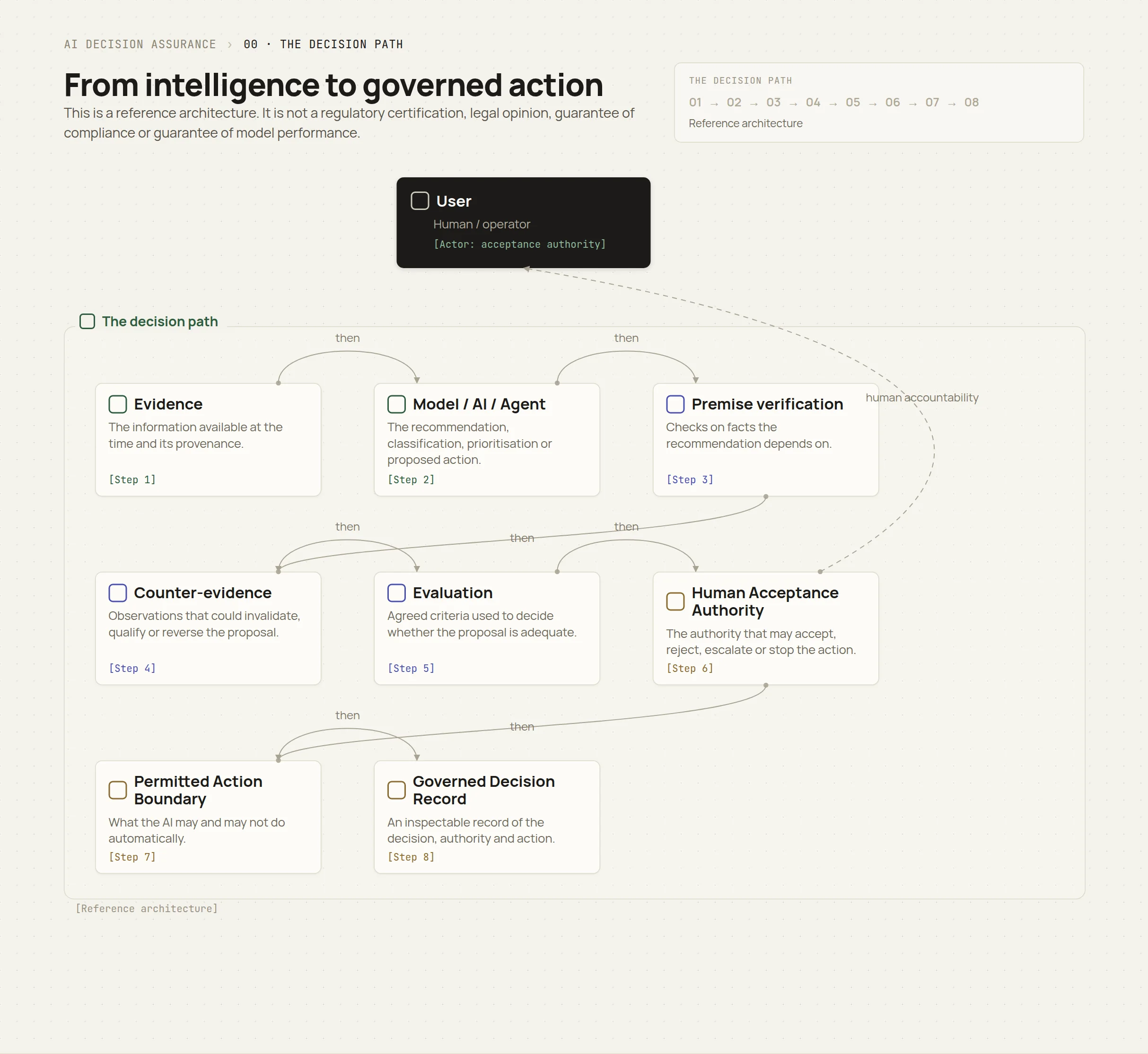
Evidence
The information available at the time and its provenance.
Model / AI / Agent
The recommendation, classification, prioritisation or proposed action.
Premise verification
Checks on facts the recommendation depends on.
Counter-evidence
Observations that could invalidate, qualify or reverse the proposal.
Evaluation
Agreed criteria used to decide whether the proposal is adequate.
Human Acceptance Authority
The identified authority that may accept, reject, escalate or stop the action when human accountability is required.
Permitted Action Boundary
What the AI may and may not do automatically.
Governed Decision Record
An inspectable record of the decision, authority and resulting action.
This is a reference architecture. It is not a regulatory certification, legal opinion, guarantee of compliance or guarantee of model performance.
Start with
one decision
The initial scope is deliberately narrow: one consequential AI-supported decision or action, reviewed read-only or shadow-first before any broader implementation.
Decision map
What the decision is, what triggers it and what consequence follows.
Evidence & provenance
What the decision relies on, where it came from and what is missing.
Failure & counter-evidence
What should challenge, suspend or overturn the recommendation.
Human Authority Matrix
Who may accept, reject, escalate or stop the action.
Action boundary
Which actions may be automated and which require explicit authority.
Decision record design
What must be preserved so the decision can be reconstructed later.
No production rewrite is required for the initial scope. Business authority remains with the client organisation.
Put one AI decision
on a page
Choose one workflow where an AI recommendation could influence a consequential action. Work through these six fields with the person accountable for that decision. Use public or synthetic information for an initial discussion.
Decision and consequence
What is proposed? What triggers it? What changes if someone accepts it?
Evidence and source versions
Which documents, observations or system records support it? What is assumed?
Conflict and counter-evidence
What contradicts the proposal? What missing fact should pause the decision?
Accountable authority
Which named person or role may accept, reject, escalate or stop this decision?
Permitted action boundary
What may the AI read, draft or recommend? Which actions require approval?
Record and evaluation
What must be saved? How will you distinguish the proposal, decision, action and outcome?
A worked example: when the documents disagree
The question. “Can this change proceed after one reviewer approves it?” Document A, version 1: one reviewer is required. Document B, version 2: two reviewers are required. Neither document establishes precedence or supersedes the other.
The useful response. “The sources disagree. Document A requires one reviewer; Document B requires two. I cannot establish which rule applies from these documents. The designated policy owner must resolve the conflict before this answer can support an action.”
A newer version number alone does not establish that one document overrides a different document. Keep the unresolved point visible.
What to record
Sources. Document IDs, versions, relevant passages and access context.
Open issue. Required reviewer count is unresolved; precedence is not established.
Authority. Designated policy owner: to be assigned. Assign a real owner before use.
Action state. Recommendation held; no operational approval is implied.
Resolution. Owner, decision, reason, time and the governing source once confirmed.
A practical evaluation
Check whether the conflict is exposed, both sources are traceable and the unresolved conclusion is kept separate from an authorised decision. A fluent answer that silently chooses a rule fails this example.
The worked example is synthetic; it is not a client case or a deployed system. A scoping aid: it does not certify compliance, replace domain review or authorise an action.
Consequential workflows
across regulated domains
Banking, insurance & payments
Credit, fraud, AML escalation, underwriting, claims, pricing, investment and customer-facing agent workflows.
Financial Services → Agentic AI GovernanceAuthority before autonomy
Evidence, escalation, human authority and permitted action boundaries around agentic workflows.
Agentic AI Governance → AI Audit TrailReconstruct the decision
Preserve evidence, system state, authority, action and outcome so a consequential decision can be reconstructed later.
AI Audit Trail → Critical InfrastructureOperational decisions
Maintenance, anomaly investigation and recommendations where physical or service consequences persist.
Critical Infrastructure →Not another model.
Not another dashboard.
SINAIGROUP-AI works around systems an organisation already operates. Models remain models. Risk, clinical, engineering and business owners retain their authority.
Decision assurance does not certify compliance, replace model validation, transfer business authority to AI, or guarantee outcomes. It makes the evidence, challenge, authority and action boundary around a consequential decision explicit and inspectable.
AI Decision Assurance
in plain language
What is AI Decision Assurance?
AI Decision Assurance examines the evidence, counter-evidence, authority, action boundaries and audit record surrounding a consequential AI-supported decision.
How is it different from model validation?
Model validation evaluates model behaviour and performance. Decision assurance examines the wider operational decision: its evidence, assumptions, counter-evidence, authority, permitted action and resulting record.
How is it different from AI governance?
AI governance defines organisational policies, responsibilities and acceptable use. Decision assurance examines how those expectations hold around an actual decision path.
What is Human Acceptance Authority?
Human Acceptance Authority identifies the person or role with authority to accept, reject, escalate or stop an AI-supported action where human accountability is required.
What should an AI decision record contain?
A useful record can include the evidence available at the time, relevant model or agent state, the proposed decision, counter-evidence, approval or rejection, authority exercised, resulting action and observable outcome.
The control layer
around the decision
Bring us one
consequential decision
Tell us what decision matters, what evidence it depends on, who is accountable for it today and what happens if it is wrong.